

 Français
 Español
 Products

 About Us



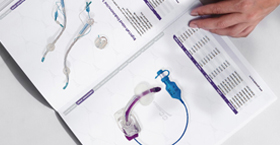

Parts of a Tracheostomy Tube: Components and Their Functions
Quick Answer
The main parts of a tracheostomy tube include the outer cannula, inner cannula, flange, cuff, pilot balloon and connector. The outer cannula forms the main airway, the inner cannula provides a removable inner passage in double-cannula designs, the flange helps stabilize the tube, the cuff creates an airway seal, the pilot balloon forms part of the cuff inflation system, and the connector links the tube with compatible respiratory equipment.
A tracheostomy tube is placed through a surgically created opening in the neck and into the trachea to maintain an airway. Although tracheostomy tubes come in different configurations, many designs share several structural components.
Understanding the parts of a tracheostomy tube and the function of each component makes it easier to understand how different tube configurations work, especially the structural differences between single- and double-cannula tracheostomy tubes.
Main Parts of a Tracheostomy Tube
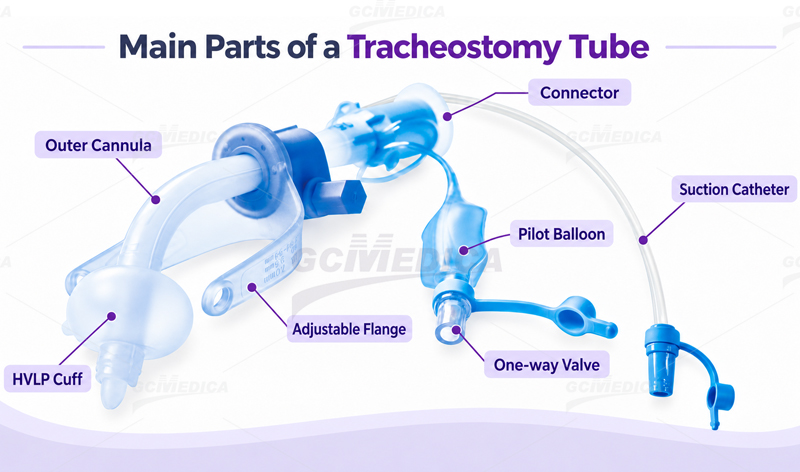
The table below gives a direct definition of six key tracheostomy tube components and explains the primary function of each part.
| Component | Definition | Main Function |
|---|---|---|
| Outer Cannula | The outer cannula is the main tube of a tracheostomy tube that is positioned through the tracheostomy opening and into the trachea. | It maintains the main airway passage through the tracheostomy. |
| Inner Cannula | The inner cannula is a removable tube that fits inside the outer cannula in double-cannula or dual-cannula systems. | It provides a removable inner airway that can be taken out for cleaning or replacement. |
| Flange | The flange is the external neck plate attached to the tracheostomy tube. | It provides attachment points for tracheostomy ties or straps and helps stabilize the tube. |
| Cuff | The cuff is an inflatable component positioned around the distal portion of a cuffed tracheostomy tube. | When inflated, it creates a seal between the tube and the tracheal wall. |
| Pilot Balloon | The pilot balloon is a small external balloon connected to the cuff through an inflation line. | It forms part of the cuff inflation system and provides an external indication that the cuff system contains air. |
| Connector | The connector is the proximal interface of the tracheostomy tube used to attach compatible respiratory equipment or accessories. | It provides the connection point between the tracheostomy tube and compatible respiratory equipment. |
1. Outer Cannula
The outer cannula is the main structural tube of a tracheostomy tube. It passes through the tracheostomy opening and remains positioned within the trachea.
What does the outer cannula do? Its primary function is to maintain the airway created by the tracheostomy and provide the main passage through which air moves.
The dimensions and shape of the outer cannula are important characteristics of the complete tube. These can include the inner diameter, outer diameter, length and curvature.
In a single-cannula tracheostomy tube, the main cannula itself forms the usable airway lumen. In a double-cannula tracheostomy tube, the outer cannula also provides the supporting structure for a removable inner cannula.
2. Inner Cannula
The inner cannula is a removable tube positioned inside the outer cannula. It is a defining structural component of many double-cannula or dual-cannula tracheostomy tubes.
What does the inner cannula do? It provides the inner airflow pathway while allowing part of the airway system to be removed for cleaning or replacement without removing the outer cannula.
This removable structure is one of the clearest differences between single- and double-cannula tracheostomy tubes. Single-cannula designs do not contain a separate removable inner cannula.
For a more detailed explanation of this configuration, seeTracheostomy Tube with Inner Cannula.
3. Flange
The flange, also called the neck plate, is the external part of the tracheostomy tube that rests against the patient's neck.
What does the flange do? Openings in the flange provide attachment points for tracheostomy ties or securing straps. These help stabilize the tube and reduce unwanted movement.
The shape and flexibility of the flange can vary between tube designs. Some specialized tracheostomy tubes may also use adjustable flanges to accommodate different anatomical requirements.
4. Cuff
The cuff is an inflatable component positioned around the distal portion of a cuffed tracheostomy tube.
What does the cuff do? When inflated, the cuff creates a seal between the tracheostomy tube and the tracheal wall. This helps reduce air leakage around the tube and can support effective positive-pressure ventilation.
Not every tracheostomy tube has a cuff. Tubes without an inflatable cuff are generally described as uncuffed or cuffless tracheostomy tubes.
Important: The primary role of the cuff is to create an airway seal. It should not be considered a complete barrier against aspiration.
5. Pilot Balloon
The pilot balloon is a small external component found on conventional cuffed tracheostomy tubes. It is connected to the cuff through a narrow inflation line.
What does the pilot balloon do? It forms part of the cuff inflation and deflation system and provides an external indication that the cuff system contains air.
Because the pilot balloon is associated with the cuff, it is normally found on cuffed tracheostomy tube configurations rather than standard cuffless designs.
6. Connector
The connector is located at the proximal end of the tracheostomy tube and provides an interface with compatible respiratory equipment or accessories.
What does the connector do? It provides the connection point through which the tracheostomy tube can be integrated with compatible respiratory equipment when required.
Depending on the tube design, the connector may be integrated with the outer cannula or associated with the inner cannula.
Other Components That May Be Included
In addition to the six main components above, some tracheostomy tube systems include other parts or specialized features. These depend on the specific tube configuration and are not present on every tracheostomy tube.
Obturator
An obturator is a removable insertion aid that fits inside the outer cannula and provides a smooth, rounded leading surface during placement. It is removed after the tracheostomy tube has been positioned.
Fenestration
A fenestration is an opening incorporated into certain tracheostomy tube designs. It is a feature of fenestrated tubes rather than a standard part of every tracheostomy tube.
Subglottic Suction Port
A subglottic suction port is an additional lumen incorporated into selected cuffed tracheostomy tubes to provide access to secretions collecting above the cuff. It is a specialized feature rather than a standard component.
Single Cannula vs Double Cannula: How Do the Parts Differ?
One important structural difference between tracheostomy tubes is whether the tube uses a single-cannula or double-cannula configuration.
| Tube Structure | Cannula Configuration | Main Structural Difference |
|---|---|---|
| Single Cannula | A single main airway cannula without a removable inner cannula. | The main cannula itself forms the usable airway lumen. |
| Double Cannula | An outer cannula plus a removable inner cannula. | The inner cannula can be removed while the outer cannula remains positioned in the trachea. |
The inner cannula is the key structural component that distinguishes many double-cannula systems from single-cannula designs.
For a more detailed comparison of the two structures, seeSingle vs Double Lumen Tracheostomy Tube.
How Do the Parts Work Together?
The different parts of a tracheostomy tube function as one airway system. The outer cannula forms the main structural airway, while the flange helps stabilize the tube externally. In double-cannula systems, the inner cannula fits inside the outer cannula and provides a removable inner airway.
When the tube is cuffed, the cuff and pilot balloon form part of the same inflation system. The connector at the proximal end provides an interface with compatible respiratory equipment.
The exact combination of components depends on the tube configuration, which is why not every tracheostomy tube contains the same parts.
Frequently Asked Questions
What are the main parts of a tracheostomy tube?
The main parts commonly discussed are the outer cannula, inner cannula, flange, cuff, pilot balloon and connector. However, not every tube contains all six components. For example, single-cannula tubes do not have a removable inner cannula, while cuffless tubes do not have a cuff or pilot balloon.
What is the function of the outer cannula?
The outer cannula forms the main structural tube of the tracheostomy and maintains the airway passage through the tracheostomy opening.
What is the difference between the outer cannula and inner cannula?
The outer cannula remains positioned in the trachea as the main structural tube. The inner cannula, when present, fits inside the outer cannula and can be removed separately.
Does every tracheostomy tube have an inner cannula?
No. A removable inner cannula is a feature of double-cannula or dual-cannula tracheostomy tubes. Single-cannula designs do not contain a separate removable inner cannula.
What is the flange of a tracheostomy tube used for?
The flange provides attachment points for tracheostomy ties or straps and helps stabilize the tube at the neck.
What does the cuff of a tracheostomy tube do?
When inflated, the cuff creates a seal between the tracheostomy tube and the tracheal wall. This can help reduce air leakage and support positive-pressure ventilation.
What is the pilot balloon connected to?
The pilot balloon is connected to the cuff through an inflation line and forms part of the cuff inflation system.
What does the connector on a tracheostomy tube do?
The connector provides the interface between the tracheostomy tube and compatible respiratory equipment or accessories.
Summary
The main parts of a tracheostomy tube each have a specific structural function. The outer cannula maintains the main airway, the inner cannula provides a removable inner passage in double-cannula systems, the flange stabilizes the tube, the cuff creates an airway seal, the pilot balloon forms part of the cuff inflation system, and the connector provides an interface with compatible respiratory equipment.
Not every tracheostomy tube contains the same combination of components. In particular, the presence or absence of an inner cannula is one of the key structural differences between single- and double-cannula tracheostomy tubes.